#659 — July 29, 2026 |
|

Postgres Weekly |
|
|
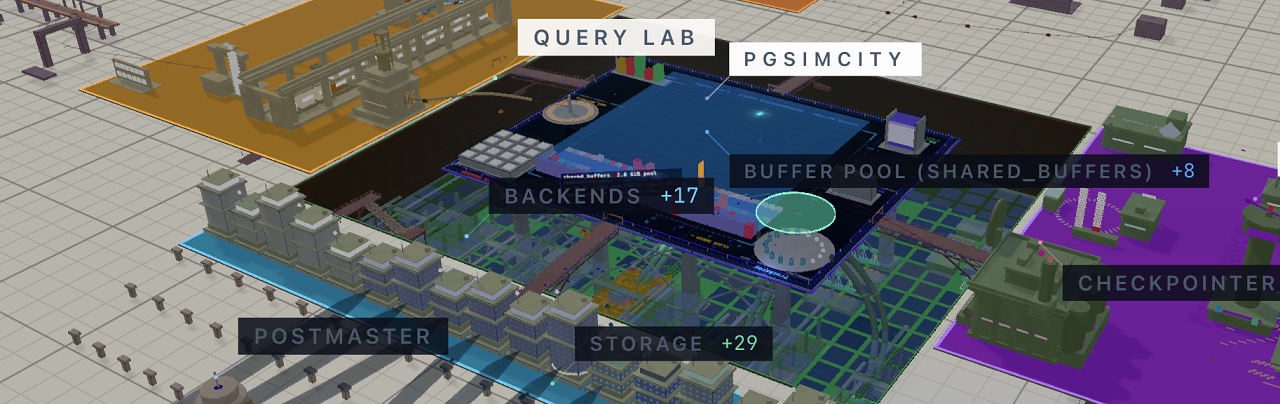
PGSimCity: How Postgres Works, in 3D — A truly novel way to explore a model of Postgres internals. It's more than a visualization, you can wander around and break stuff! It's a little 'busy' and not perfect UX-wise (you might struggle on mobile devices) but offers a fresh perspective on some otherwise opaque technical concepts. Nikolay Samokhvalov |
|
Three New Things in Postgres 19 — PlanetScale takes its turn to reflect on the upcoming release, focusing on Ahmed Darwich |

Search Without a Second System — One Postgres for your application data, full-text search, vector retrieval, and aggregations. ParadeDB is an open-source Postgres extension that keeps pace with Elasticsearch. ParadeDB sponsor |
|
Autovacuum Tweaks Coming to Postgres 19 — Autovacuum has always worked through tables in catalog order, but Postgres 19 teaches it to triage with tables scored on factors like wraparound risk and dead tuples, so the most deserving cases get tackled first. Shaun Thomas (pgEdge) |
|
Postgres's MVCC is Bad, But So is Everyone Else's — Andy Pavlo's database group called MVCC the part of Postgres they hate the most, and Radim agrees, with benchmarks. But then he asks: what do Oracle, InnoDB, SQL Server, MongoDB and etcd do instead, and what does that cost? Radim Marek |
💡 Not everyone's sold, though. In this Hacker News comment, Skeema author Evan Elias pushes back on the InnoDB characterization. |
|
The Startup's Postgres Survival Guide — A startup has opened up its internal guide distilling two years of Postgres battles, from schema rules and compound indexes to autovacuum tuning, Alexander Belanger (Hatchet) |
|
The Right Way to Give a Third-Party DBA Access to Your Database — From the basics of creating a scoped role to providing safe access to monitoring, being able to cancel runaway queries, and even vacuuming and reindexing, without handing over ownership or superuser access. Shridhar Khanal (Stormatics) |
|
Why Your Pioneering Postgres Feature Should Start in a Fork — A Postgres planner contributor on his three attempts at parallel scans over temporary tables, undone by local buffers and read-only queries that dirty pages anyway. A fork was the place to prove it, he says, because core's 'bar is brutal'. Andrei Lepikhov |
|
📄 Let's Break Autovacuum: Reproducing Failures to Make It Observable Nikolay Sivko (Coroot) |
|
|
RELEASES AND CODE: |
|
Pagila 4: A Sample Database for Postgres — Originally a port of MySQL's Sakila example database, Pagila has been extended to support numerous Postgres-specific functions (like SQL/JSON and UUIDv7) and v4.0 (which requires Postgres 18) is much larger with a more diverse dataset. Devrim Gündüz |
|
pgGraph 1.0: Add Graph Database 'Superpowers' to Postgres — An extension that brings the ability to run graph search, traversal, shortest path, and relationship queries directly against ordinary tables. Evokoa |
|
Rainfrog 0.4: A Database Management TUI for Postgres — Think a little more structured than Carl Liu |
|
|
Got a new email? You can change your address here. Bored of us? Click here to stop getting Postgres Weekly. Got a link for us? Reply and tell us. We can't include everything but we'll look at anything you send. Thanks! Published by Cooper Press Ltd. Postgres, PostgreSQL and the Slonik Logo are trademarks or registered trademarks of the PostgreSQL Community Association of Canada. |